
Basic Structure of Strata
Composition of the Alluvial and Diluvial Deposits
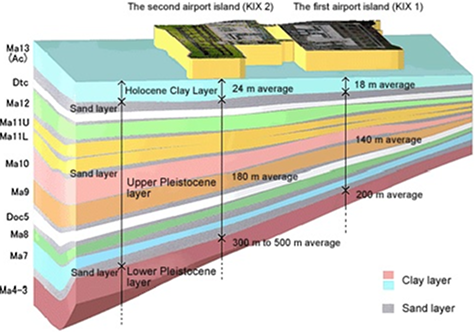
The seabed under Kansai International Airport is made up of layers of sand and clay.
The clay layer at the surface of the formation is called the Holocene Layer, approximately 20 m in thickness. After this one comes the Pleistocene layer, consisting of alternating layers of hard clay and gravel, which altogether is hundreds of meters deep. The Pleistocene layer can be divided into upper and lower level parts. The hardness of the upper level is less than the lower level layers, such that the upper layers give a little when submitted to strong pressure.
Formation Processes of Strata
Formation of Alluvial Deposits (after the last glacial period)
The alluvial deposits are strata that have accumulated during the Quaternary Holocene epoch, from approximately 10,000 years ago, after the end of the last Ice Age, to the present. This location has remained underwater from 10,000 years ago to the present, never becoming land. During this time, sediments gradually accumulated, forming the alluvial clay layers.
Formation of Diluvial Deposits (approximately 2 million years ago to present)
The diluvial deposits are strata that accumulated during the Quaternary Pleistocene epoch, from approximately 2 million years ago to about 10,000 years ago. A characteristic of this period is that ice ages and interglacial periods alternated every several tens of thousands of years. During ice ages, temperatures dropped, causing seawater to freeze and sea levels to fall. On the other hand, during interglacial periods, temperatures rose, causing the ice to melt and sea levels to rise. The range of these sea level fluctuations exceeded 100 m, and due to these changes in sea level, Osaka Bay has transformed between sea, lake, and land over cycles of tens to hundreds of thousands of years.
The Unique Sandwich-like Stratigraphic Structure of Osaka Bay
Clay accumulates on the seabed when the ground is under water, and sand accumulates on the ground when the water level decreases and the ground emerges from underwater. Additionally, the movement of the earth's crust slowly lowered the seabed, increasing the depth of the Osaka Bay in Pleistocene times. As the Osaka Bay deepened, clay and sand accumulated on the floor of the seabed almost without exposure to strata erosion by rivers or rain.
As shown on the picture below, the Pleistocene formation of the Osaka Bay is comprised of alternating layers of clay and sand.